What If Likes Didn't Exist? Would We Still Share?
A thought-provoking look at how the hunger for likes is changing our relationships, shaping our identities, dividing society and making us forget the value of being ourselves.

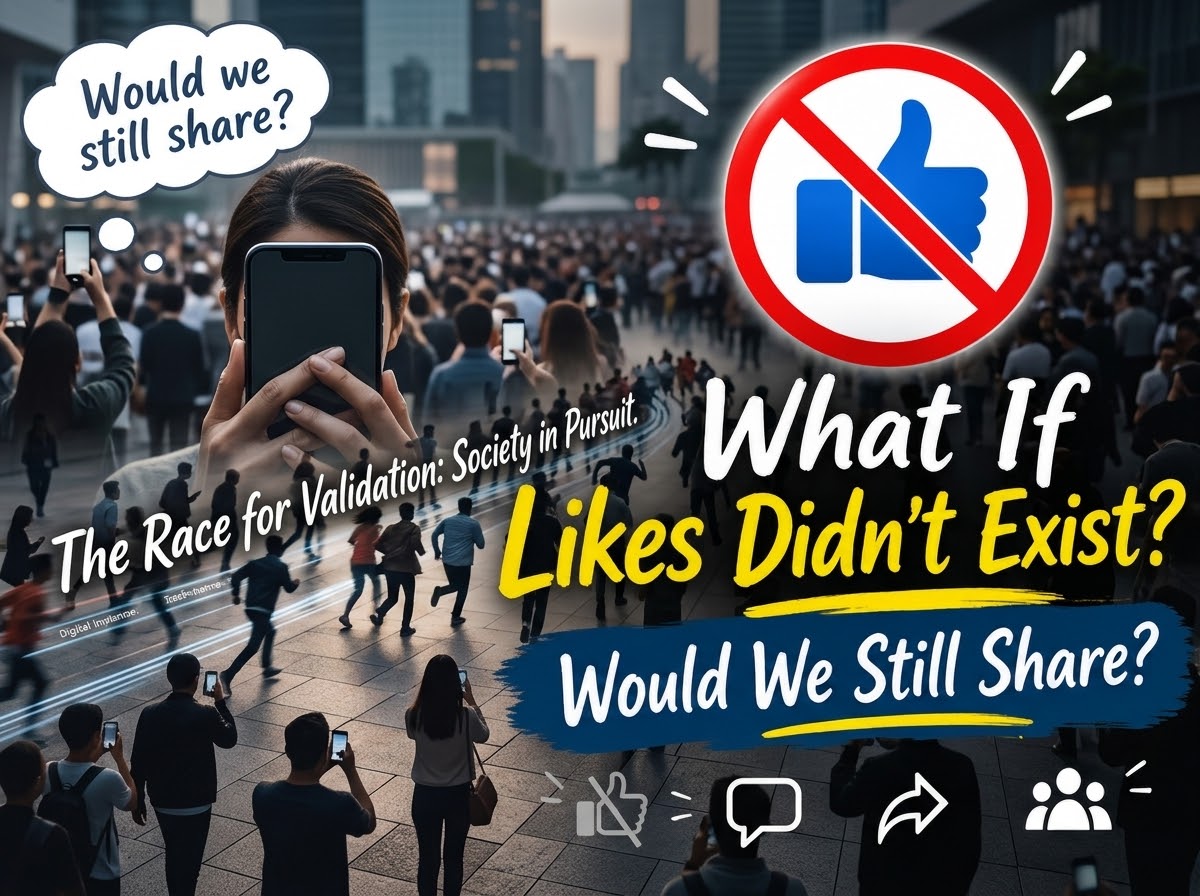
Imagine waking up tomorrow and discovering that Facebook, Instagram and every other social media platform have removed the Like button.
You can still post pictures, share videos, express opinions, upload family moments and tell the world what's happening in your life. People can still see your posts, but nobody knows how many people liked them.
Would you still post that picture? Would you still share your achievements? Would you still spend time creating the perfect photograph, writing the perfect caption or showing everyone how wonderful your life is?
Or would something suddenly feel missing?
It's an interesting thought, isn't it?
We often say social media is just a way to stay connected, but somewhere along the way, it has become much more than that. It has started influencing how we dress, where we go, what we buy, how we celebrate and sometimes even how we feel about ourselves.
And perhaps the biggest question is this: Are we living our lives anymore, or are we slowly learning to perform them for an audience?
When Appreciation Became a Competition
There was a time when happiness didn't need an audience.
A family dinner was special because everyone was together. A holiday was memorable because of the experience. A birthday was exciting because the people we loved were around us.
Today, many of these moments come with an additional responsibility: making sure they look good online.
Before enjoying the food, someone needs a photograph. Before leaving a beautiful place, there must be a perfect picture. Before celebrating an achievement, we are already thinking about how to announce it.
And once the post is uploaded, the waiting begins.
Who has seen it? How many people liked it? Why has that person not reacted? Why did someone else's picture receive so much more attention?
Something that was supposed to be a happy moment can suddenly become a measure of popularity.
The strange part is that we may have enjoyed the moment perfectly well before posting it. But after sharing it, our happiness sometimes starts depending on how others respond.
We wanted to share a memory, but somehow ended up waiting for approval.
The Life We Show and the Life We Actually Live
Perhaps one of the biggest changes social media has brought into our lives is the difference between who we are and who we want others to believe we are.
We see people enjoying luxurious holidays, expensive restaurants, beautiful homes, perfect relationships and seemingly successful careers.
Everything looks wonderful.
But how much of it is real?
Someone might be struggling financially but still feel the pressure to display an expensive lifestyle. A person going through a difficult relationship might continue posting romantic photographs. Someone who feels lonely might constantly upload pictures surrounded by people.
Why?
Because somewhere in our minds, we have started believing that being admired is almost as important as being happy.
We carefully select what people should see. We show the celebrations but hide the arguments, the holidays but not the financial stress, the achievements but rarely the failures.
There is nothing wrong with sharing happy moments. We all deserve to celebrate life.
The problem begins when we start creating an image that doesn't represent our reality.
A person can look incredibly successful online and still be struggling to pay their bills. Someone can have thousands of followers and have nobody to call when life becomes difficult.
And perhaps the saddest part is that we sometimes become so busy convincing others that we are happy that we forget to ask ourselves whether we actually are.
When Likes Start Dividing Society
This is where the issue becomes bigger than individual behaviour.
Likes have quietly become a form of social currency.
People with large followings are often treated as more important, more influential and sometimes even more valuable than those who live ordinary lives.
A person with thousands of followers may receive more attention than someone with genuine knowledge, experience or something meaningful to say.
A small business owner working honestly for years may struggle to get noticed, while someone promoting a lifestyle they barely live can attract enormous attention.
We have started giving visibility the importance that should belong to character.
This creates an unhealthy divide.
People begin judging others by their online popularity, lifestyle, appearance and possessions. Some feel inferior because they cannot afford what others display. Others begin believing they are superior simply because their posts receive more attention.
Even friendships can become complicated.
Why did they like someone else's picture but ignore mine? Why do they comment on that person's posts but never on mine? Why wasn't I invited when everyone else was?
Small digital interactions begin creating unnecessary doubts, jealousy and distance in real relationships.
And sometimes, people who genuinely care about each other start measuring that care through social media behaviour.
Imagine how strange that is.
We can sit beside someone, share a meal, laugh together and still feel disappointed because they didn't like our photograph later that evening.
Have we really reached a point where an online reaction can matter more than a real-life connection?
The Pressure to Become Someone We Are Not
Think about how many decisions we make because we want to look a certain way in front of others.
We buy things we don't necessarily need because they look impressive. We visit places mainly because they are popular. We sometimes spend beyond our means to maintain an image.
Even opinions and personal beliefs can become part of the performance.
Some people share strong opinions not because they have deeply thought about an issue, but because controversy attracts attention. Others exaggerate stories, create unnecessary drama or present themselves as experts simply to gain followers.
The more shocking the content, the more attention it can attract.
And unfortunately, attention doesn't always reward honesty, kindness or intelligence.
Sometimes it rewards the loudest voice, the most dramatic story or the most unrealistic display of life.
Slowly, the line between expressing ourselves and performing for an audience becomes blurred.
We begin asking, "Will people like this?" before asking, "Is this really me?"
That is a worrying change.
Because when we repeatedly pretend to be someone else for public approval, eventually we risk losing touch with the person we actually are.
What Are We Teaching the Next Generation?
Perhaps the most concerning part of this culture is what our children are learning from it.
Young people are growing up in a world where popularity can be counted, appearance can be rated and attention can be measured.
Imagine being a teenager who uploads a photograph and receives fewer likes than a classmate.
It might seem like a small thing to an adult, but for a young person still discovering their identity, it can feel deeply personal.
They may begin questioning their appearance, their popularity or whether they are interesting enough.
Some start changing the way they dress, speak and behave to fit what seems popular online.
Others feel pressure to participate in trends they don't even enjoy.
And when the desire for attention becomes strong enough, some may take unnecessary risks, reveal too much of their private lives or create content that doesn't reflect their values.
What message are we sending them?
That being noticed is more important than being genuine? That popularity is more important than personality? That a person's value can be measured by how many people react to their pictures?
We keep telling young people to be themselves, while the digital world around them constantly encourages them to become someone more noticeable.
That contradiction deserves serious thought.
What If Nobody Could Like Our Posts?
Let's return to our original question.
Imagine a social media world where there are no likes, no visible reaction counts and no popularity rankings.
You upload a photograph because you love it. You share a personal achievement because you are proud of yourself. You post an opinion because you believe it deserves to be heard.
Nobody can measure how popular your post is.
Would you still feel the need to show off an expensive holiday? Would you still pretend to have a perfect relationship? Would you still buy something just to photograph it? Would you still compare your life with someone else's?
Perhaps some people would continue doing these things. After all, the desire for recognition existed long before social media.
But removing likes might take away one of the easiest ways of measuring public approval.
It could encourage people to share more honestly, communicate more meaningfully and spend less time competing for attention.
We might discover that a photograph shared with ten people who genuinely care can mean more than one seen by ten thousand strangers.
And perhaps we would finally stop treating every ordinary moment as an opportunity to impress someone.
Maybe We Don't Need More Likes. We Need More Real Connections.
There is nothing wrong with social media. It has connected families across continents, helped businesses grow, given talented people a platform and allowed ordinary voices to reach the world.
But technology should make our lives better, not make us question our worth.
We shouldn't feel less attractive because someone else's picture received more attention. We shouldn't feel unsuccessful because someone displays a more expensive lifestyle. We shouldn't measure our friendships through comments and reactions.
And most importantly, we shouldn't have to pretend that our lives are perfect just to make them look interesting.
Life is not a collection of photographs.
It is the difficult mornings nobody sees, the responsibilities we carry quietly, the sacrifices we make for our families, the disappointments we overcome and the small moments of happiness that never make it online.
Some of the most beautiful things in life will never receive a single like.
A parent working late to give their children a better future. A friend who shows up when everyone else disappears. A person helping someone without telling the world. A family laughing together around a simple dinner table.
These moments may never become popular posts, but they are the moments that actually matter.
Perhaps the real question isn't whether we could live without likes. It's whether we have started living differently because of them.
And if tomorrow nobody could see how many people appreciated our posts, would we finally feel comfortable being ourselves?
Let's Talk!
Imagine social media removes the Like button tomorrow.
Would you continue sharing your everyday life, achievements, photographs and experiences just as you do today?
Or do you think many people would stop posting because the appreciation they receive online is part of what motivates them?
And one more question worth thinking about: Are we using social media to share our lives, or have we started changing our lives to impress social media?
I'd love to hear your honest thoughts in the comments.