Can We Survive a Day Without This Little Gadget We Call a Mobile Phone?
We carry it everywhere, check it hundreds of times, and sometimes give it more attention than the people sitting right beside us. But what would happen if we put it away for 24 hours?
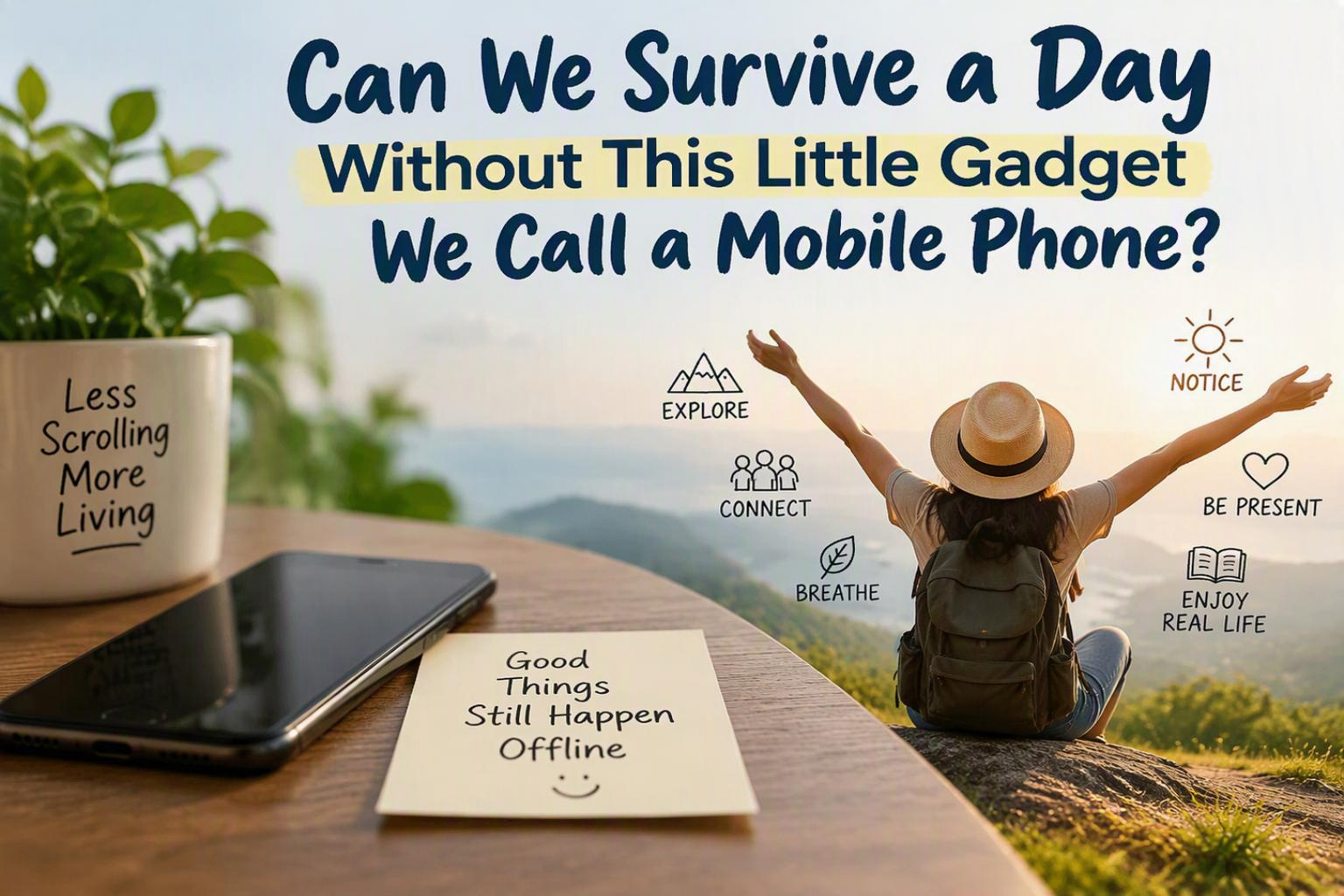
Let's be honest. What is the first thing many of us do after opening our eyes in the morning?
We reach for our mobile phones.
Before we've properly woken up, we're checking WhatsApp, scrolling through Instagram, reading emails, or finding out what happened in the world while we were asleep.
Twenty minutes later, we're still in bed, and the day hasn't even started.
Now imagine someone challenging you to spend an entire day without your mobile phone.
No social media. No YouTube. No unnecessary messages. No checking notifications every few minutes.
Just you, your thoughts, your family, your work, and the world around you.
Would you feel relaxed, or would you feel as though something important had been taken away?
Let's find out.
The Little Gadget That Became Our Whole World
There was a time when mobile phones were mainly used to make calls and send text messages. If you wanted to meet a friend, you agreed on a place and time. If you wanted to know something, you asked someone, opened a book, or looked it up.
Today, our phones are alarm clocks, cameras, wallets, maps, shopping centres, entertainment systems, offices, and libraries—all in one small device.
For people living away from their families, a simple video call can bring loved ones thousands of miles away into the same room. For businesses, mobile technology makes communication faster and everyday tasks easier.
There is no denying that mobile phones have transformed our lives for the better.
But somewhere along the way, we may have become so dependent on them that even a few minutes without a screen feels uncomfortable.
Waiting for a lift? Check the phone.
Standing in a queue? Check the phone.
Sitting in traffic? Check the phone.
Even when we have nothing to do for 30 seconds, we reach for something to look at.
When did being alone with our own thoughts become so difficult?
Perhaps the real question isn't whether mobile phones are good or bad.
It's whether we are using our phones—or allowing them to control our attention.
Are We Missing Life While Trying to Capture It?
Think about the last wedding, family dinner, or holiday you attended.
How much time did you spend enjoying the experience, and how much time did you spend recording it?
We photograph our food before eating it, record concerts through our screens, and visit beautiful places while worrying about which picture will look best online.
Of course, photographs preserve precious memories. Years later, a single picture can bring back feelings we thought we'd forgotten.
But there is a difference between capturing a moment and actually experiencing it.
Imagine sitting beside the sea at sunset. The sky is turning orange, the breeze is gentle, and the sound of the waves makes everything feel peaceful.
You could spend those minutes searching for the perfect angle, editing a photograph, and writing a caption.
Or you could put your phone away and simply enjoy the view.
The sunset will be beautiful either way.
But only one option allows you to experience it without distraction.
Perhaps the best memories aren't always the ones we upload. Some are the ones we quietly carry in our hearts.
The Family Sitting Together but Living in Different Worlds
Picture a family sitting together after dinner.
One person is watching videos, another is replying to messages, and the children are playing games. Everyone is physically present, but nobody seems particularly interested in what anyone else is doing.
A parent asks a child about school and receives a distracted answer. A partner starts sharing something about their day, but a notification interrupts the conversation.
Nobody is deliberately being unkind. Everyone is simply distracted.
And gradually, this becomes normal.
Relationships are not built only through expensive gifts, special holidays, or grand gestures. They grow through ordinary conversations, shared laughter, and the feeling that someone genuinely wants to listen.
Sometimes, the most meaningful thing we can give another person is our undivided attention.
Imagine introducing one simple rule at home: during dinner, everyone puts their phone away unless there is a genuine emergency.
Initially, someone might complain that there is nothing to do.
Then a conversation begins. Someone tells a funny story. A child asks an unexpected question. People laugh.
Nothing extraordinary has happened.
Yet something valuable has returned to the room.
Human connection.
What Is Constant Screen Time Doing to Our Minds?
Our phones offer an endless supply of new things to see. Messages arrive, videos play, headlines appear, and social media feeds constantly refresh.
We pick up the phone to answer one message and suddenly discover that half an hour has passed.
Sometimes, the problem isn't even the amount of information we consume. It's how easily that information distracts us from our own lives.
We see someone with a better job, a bigger house, an exciting holiday, or what appears to be a perfect relationship. Even when we know social media shows only selected moments, we can still begin comparing our everyday reality with somebody else's highlights.
We may start questioning our progress simply because another person appears to be moving faster.
Then there is the effect on concentration. We sit down to read a book, but a notification appears. We start working, then check a message. We begin a conversation, then glance at the screen.
Our attention is repeatedly pulled elsewhere.
Taking a break from our phones will not solve every problem, but creating periods without digital distractions can give us more opportunities to concentrate, relax, and enjoy what we are doing.
Sometimes, the mind needs a little quiet.
Not another video. Not another notification.
Just quiet.
Can We Really Live Without Our Phones Today?
Let's be practical. For many people, going an entire day without a mobile phone would be difficult.
We use navigation apps to find our way, digital payments to buy groceries, authentication codes to access work systems, and messaging apps to coordinate family responsibilities.
For people managing businesses, travelling, or caring for loved ones, switching off completely may not even be sensible.
And nobody needs to reject technology to regain control of their time.
The solution is to use our phones more intentionally.
Keep essential calls available, but disable unnecessary notifications. Use navigation when you need it without automatically opening social media. Check work messages at reasonable intervals rather than feeling obliged to respond every minute.
You can also establish phone-free periods during meals, family time, or the first part of your morning.
The aim isn't to disappear from the modern world.
It's to stop giving every app unlimited access to your attention.
The 24-Hour Challenge: What If We Actually Tried It?
Imagine spending one day avoiding unnecessary phone use.
You don't need to switch off every essential service. Simply become more conscious of how often you reach for your device.
Here is a challenge anyone can try.
1. Start your morning without scrolling.
Give yourself the first 30 minutes of the day without social media. Get ready, enjoy breakfast, and allow yourself to wake up before the notifications begin.
2. Eat one meal without a screen.
Put the phone aside and enjoy your food. If you're with family, use that time to talk rather than scroll.
3. Have one meaningful conversation.
Speak to a friend, call a family member, or spend time with someone without repeatedly checking your screen.
4. Rediscover something you enjoy.
Read a book, cook, exercise, take a walk, play a board game, or return to a hobby you've neglected.
5. Let yourself be bored.
The next time you're waiting somewhere, resist the urge to reach for your phone immediately. Observe your surroundings and let your thoughts wander.
6. Reflect before going to bed.
Ask yourself: Did I feel anxious without my phone? Did I notice things I usually overlook? Did I enjoy any moment more because I wasn't distracted?
There are no right or wrong answers. The purpose is to understand your habits.
If a whole day feels impossible, start with two hours—or even 30 minutes.
Small changes count, too.
What If We Miss Something Important?
This is a reasonable concern. What if someone messages us? What if an urgent update arrives? What if something happens and we don't know about it immediately?
Our phones are important tools, and we should continue using them when necessary.
But consider another question: how many notifications we receive are genuinely urgent?
How many messages can wait 20 minutes? How many updates could we check later? How many notifications are simply apps competing for our attention?
We have become accustomed to treating almost every alert as something that requires an immediate response.
Yet not every message is an emergency, and not every update needs to be seen the moment it appears.
Being available all the time is not the same as being productive all the time.
We can be responsible, reachable, and informed without responding to everything instantly.
The trick is learning to distinguish between what matters and what merely demands our attention.
The Real Question Isn't About the Phone
Perhaps the most interesting question isn't whether we can survive 24 hours without a mobile phone.
It's whether we can comfortably spend time without constant digital stimulation.
Can we sit quietly without feeling the need to check something?
Can we enjoy a meal without photographing it?
Can we read a few pages of a book without reaching for our phones?
Can we spend time with our families without repeatedly looking at a screen?
These questions matter because life is made up of small moments: a conversation with a parent, a child's unexpected joke, a peaceful morning, or a cup of tea with someone we love.
None of these moments needs to become a social media post to have value.
We don't need to use our phones less in every situation. We need to become more intentional about when we use them and when we put them away.
Technology should enrich our lives, not distract us from the lives we are already living.
One Last Thought Before You Pick Up Your Phone Again
Tonight, when you finish reading this article, try something simple.
Put your phone aside for 15 minutes.
If your family is nearby, spend some time with them. If you're alone, enjoy a little quiet. Open that book you've been meaning to read, or have a conversation you've been postponing.
You don't have to do anything extraordinary.
Just be present.
The world will continue moving. Messages will arrive, videos will be uploaded, and people will share photographs of their meals, holidays, and achievements.
You can catch up later.
For a little while, let yourself be where you actually are.
Because a mobile phone is a wonderful invention. It connects us across continents, puts knowledge at our fingertips, and makes countless everyday tasks easier.
But it cannot experience our lives for us.
It cannot replace the warmth of a genuine conversation, the comfort of a shared laugh, or the peace of a moment when we have nowhere else to be.
We don't need to give up our phones. We just need to make sure we haven't given up too much of ourselves to them.
Perhaps the best question isn't whether we can survive a day without our mobile phones.
It's whether we're truly enjoying the days we spend with them.
Now, It's Your Turn!
Be honest: Could you spend an entire day without your mobile phone?
Would you feel anxious, bored, relaxed, or surprisingly free?
Share your thoughts in the comments. Your experience might help someone else rethink their own digital habits.
BooksShore — Read. Learn. Grow. Together.